

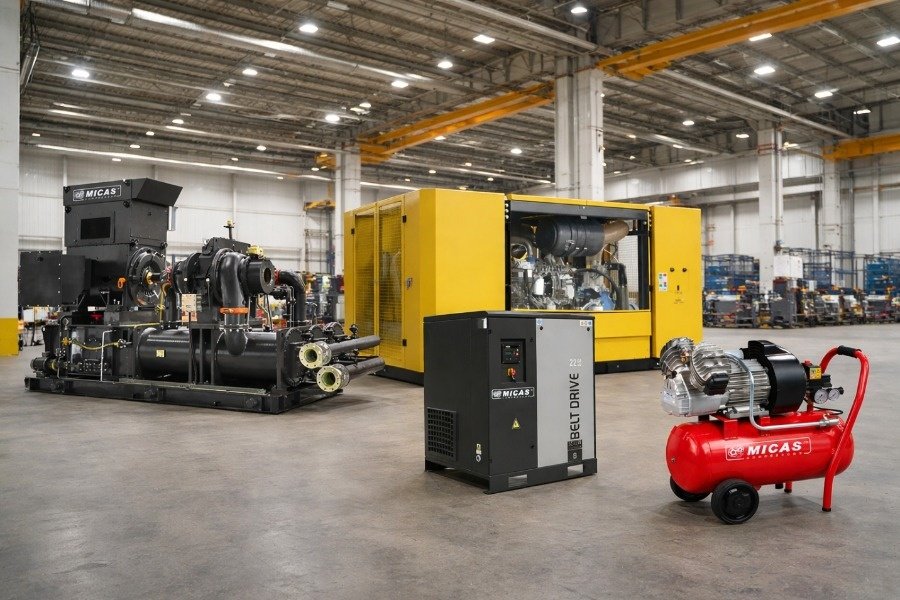
From small workshops to petrochemical facilities, various industries rely on the appropriate choice ofcompressorto operate efficiently. A wrong selection can lead not only to wasted energy but also to soaring maintenance costs. This is where understanding the types of compressors and their applications becomes essential.
Classification of Industrial Compressors
Before diving into the models, it is crucial to understand that compressors can be categorized based on their operational mechanisms, lubrication types, and power sources. Each category has its own advantages and limitations, and knowing them leads to precise and optimal selection.
Based on Operational Mechanism
- Positive Displacement:Air is mechanically compressed in fixed volumes; suitable for high pressure and steady flow.
- Dynamically:This type uses the kinetic energy of rotating blades to increase air pressure; ideal for high flow rates and continuous operation.
Based on Lubrication Type
- Oil-Injected:Oil is injected into the cylinder to reduce friction and cool the air; it provides high efficiency but requires careful maintenance.
- Oil-Free:Operates without oil; it is an unmatched choice for food and pharmaceutical industries that require clean air.
Based on Power Source
- Electric:They rely on direct energy from the electrical grid; they are quiet and cost-effective in maintenance.
- Diesel:They operate independently of electricity; suitable for remote environments and mobile projects.
Introduction to Different Types of Industrial Compressors
Screw Compressor
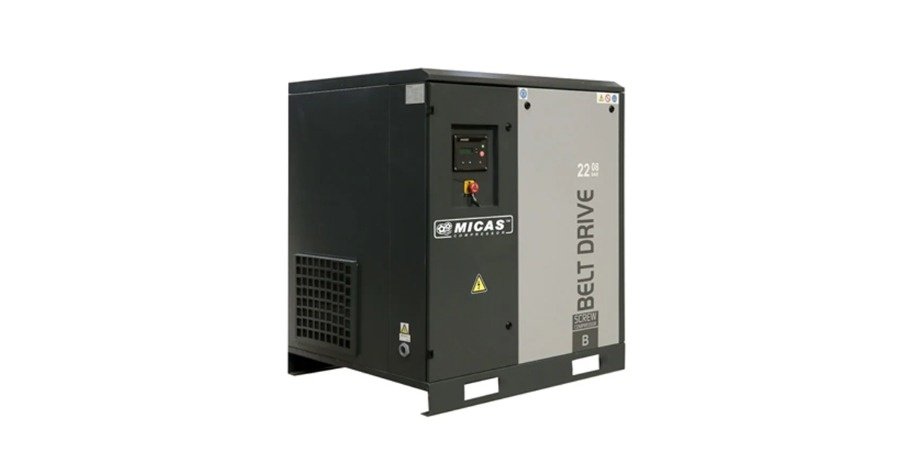
The screw compressor is one of the most popular options in medium and heavy industries because its air compression process is entirely continuous and seamless. In this compressor type, two helical rotors are housed within a cylinder, one is male and the other is female. Air enters the space between these two rotors and, with the precise and synchronized rotation of the rotors, the volume of air gradually decreases while its pressure increases. Unlike piston compressors, which produce air pulses with each back-and-forth movement of the pistons, screw compressors deliver a steady and smooth airflow, which is vital for industrial production lines and pressure-sensitive equipment.
Advantages
- Steady and Pulse-Free Airflow:This feature ensures that the tools and machines connected to the system receive the air they need without vibrations or disruptions in performance.
- Long Lifespan and Lower Maintenance Compared to Piston Compressors:The simpler rotor designs and fewer moving parts reduce the need for constant maintenance.
- Low Noise Operation and Reliability at High Pressure:Due to the continuous movement of rotors, screw compressors produce less noise and vibration while maintaining stable and reliable performance even at high pressures.
Applications
Screw compressors, because of their unique features, are widely used in industrial production lines, large workshops, and heavy industries:
- Petrochemical Industries:Providing compressed air for chemical processes and precision instruments.
- Automotive Industries:Painting lines, assembly, and pneumatic tools.
- Large Workshops and Factories:Where a continuous and stable air supply is crucial.
Submodels
- Oil Injected Screw:
This model uses oil lubrication that helps reduce friction, cool air, and enhance compressor efficiency. It is ideal for industrial applications with high pressure and continuous operation. - Oil-Free Screw:
Works without oil and delivers completely clean air. Suitable for food, pharmaceutical, and medical industries where even minimal air contamination is unacceptable. - Variable Speed Drive (VSD):
By automatically adjusting the rotor speeds based on air demand, it optimizes energy consumption and reduces operational costs. This feature is especially valuable for factories where air consumption fluctuates.
Piston Compressor
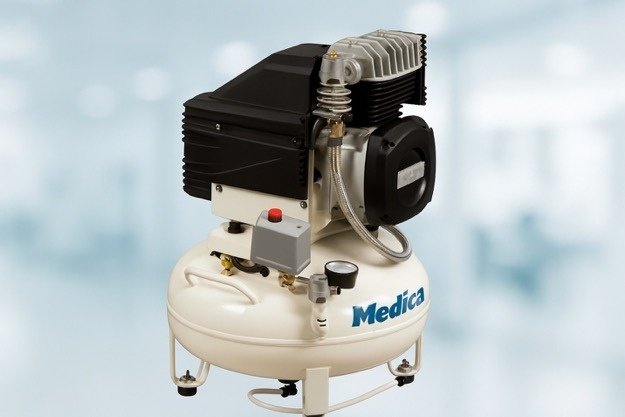
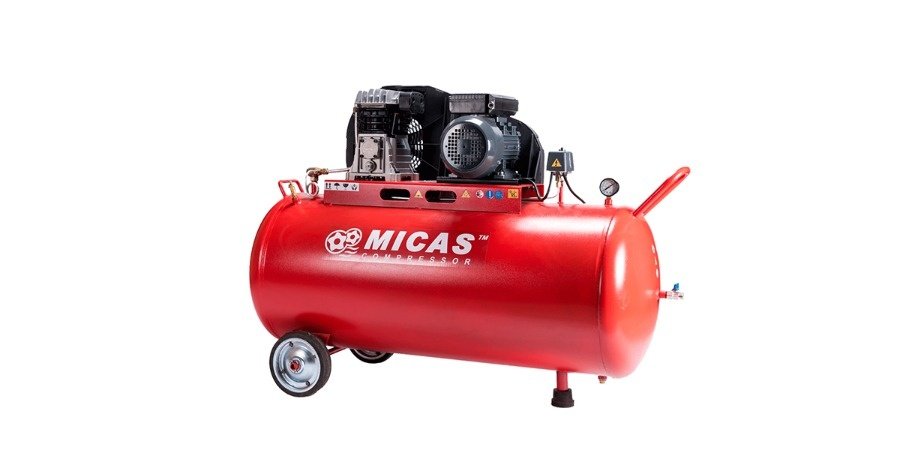
The piston compressor is one of the oldest and most recognized types of air compressors and operates based onthe reciprocating motion of the piston within the cylinder.Air enters the cylinder through the intake valve, and as the piston moves upward, the air volume decreases, and its pressure increases. The compressed air is then directed out through the exhaust valve to the reservoir or distribution system.
The number of cylinders and piston sizes determine theflow rate and output pressure.Thus, piston compressors can vary from a small cylinder suitable for limited workshops to several large cylinders for higher pressures.
Advantages and Disadvantages
- Advantages: High pressure in a compact size, low initial cost.
- Disadvantages: Produces air pulses, requires more maintenance, generates higher noise levels.
Applications
- Small and medium workshops.
- Industries with intermittent high pressure requirements.
- Air for hand tools and pneumatic equipment.
Types
- Single Stage:Compression occurs in one stage, suitable for medium pressure.
- Two Stage:Compression occurs in two stages for high pressures.
- Weak Pressure / Strong Pressure:Based on the requirements of production lines.
Oil-Free Compressor
Difference from Oil-Filled Compressors
These compressors operate without oil and deliver completely clean, oil-free air.
Manufacturing Technology
The cylinders and rotors are made with special coatings or wear-resistant materials to control friction and heat.
Target Industries
- Pharmaceutical:Production of powdered or injectable medications.
- Food:Packaging and filling lines.
- Medical:Hospitals and laboratories.
Scroll Compressor
Spiral Structure
Two overlapping spiral plates, one fixed and the other moving, compress air in a staged manner.
Low Noise Advantage
Suitable for environments where noise must be kept to a minimum, such as hospitals or laboratories.
Sensitive Applications
- Medical industries.
- Semi-conductor and electronics production lines.
Centrifugal Compressor
Dynamic Mechanism
Air is accelerated by the centrifugal force of rotating blades and gains pressure.
High Flow Capacity
Suitable for industries that require a very high airflow at medium pressure.
Applications in Heavy Industries
- Petrochemicals.
- Steel and heavy industries.
- Power plants.
Diesel Portable Compressor
Diesel Engine Structure
The diesel engine provides the necessary power for compressing air, making the system fully independent.
Mobility Advantage
Portable and usable in remote areas without access to the electrical grid.
Project and Mining Applications
- Mining workshops.
- Construction and roadwork projects.
- Mobile industrial operations.
Comparative Analysis of Compressor Types (Quick Selection Guide)
Comparison Table
| Type of Compressor | Efficiency | Cost | Maintenance Cost | Continuous / Intermittent Operation |
|---|---|---|---|---|
| Screw | High | Medium | Low | Continuous |
| Piston | Medium | Low | Medium | Intermittent |
| Oil-Free | High | High | Medium | Continuous |
| Scroll | Medium | High | Low | Continuous |
| Centrifugal | High | High | Low | Continuous |
| Diesel | Medium | Medium | Medium | Project-Based |
Why Choosing a Reliable Supplier Matters?
Equipment Authenticity
Original equipment offers better lifespan and performance.
Warranty and Services
Fast and standard support ensures peace of mind.
Technical Consultation Before Purchase
A wise choice requires thorough evaluation of your industry’s conditions and needs.
Source:Mikas Compressor